
PedalSpice was built by a pedal designer.
It's a circuit simulator for guitar pedal builders, and it exists because the tools that came before it were never made for the way pedal people work.
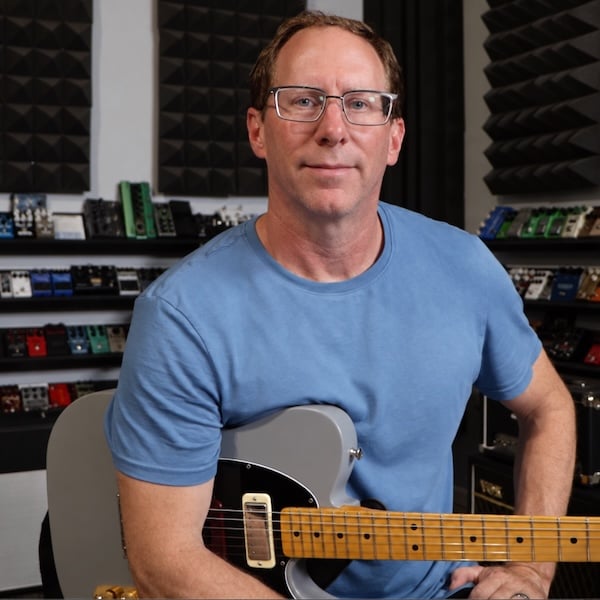
I’m Brian Wampler. My story started when I was a young guitar player and a “gear nut,” always experimenting with different guitars, amps, and pedals to find that perfect sound. I got hooked watching my older brother’s band practice when I was a kid, and from then on I wanted the best tone I could get. I wasn’t happy with the stock pedals on the market, so I started modding and tweaking them. Pretty soon I realized I could create entirely new designs that sounded unlike anything else out there. That’s how Wampler Pedals got started. Since then I’ve designed thousands of pedal circuits, including pedals for some well-known artists, and I teach pedal design at GuitarPedalCourse.com.
I approach designing guitar pedal circuits differently than most people. To me, it’s art. It’s the sound I’m hearing in my head. Most people think of audio electronics as math and physics, but to me it’s a lot more like songwriting, drawing, painting, even playing guitar.
Since the early 2000s, I’ve made it my personal goal to help musicians all over the world take the sound they hear in their head and get it in front of them as a guitar pedal. For a lot of people starting out, that feels like a huge job. It feels impossible, and I’ve always wanted to help them see that it doesn’t have to be. That’s the whole reason I started helping others with DIY guitar pedals to begin with.
I’ve always had a love-hate relationship with circuit simulation software, like all the different SPICE programs out there. You need software that gets your ideas in front of you and lets you test things quickly, but most of it is way more complicated than it needs to be.
For 20 years, every time I had a new idea, I had a couple of choices.
I could breadboard it, which tells you what it sounds like, but it can take an afternoon or even a couple of days to get it to the point where you’re somewhat happy. Breadboarding can also be a bit mechanical. It doesn’t really let you think creatively about all the options in front of you. It’s like trying to paint with only a handful of colors, because you can’t really see all the colors you have to work with.
Or I could use a simulator. That was a big help, because I could draw the whole idea out and try things fast. What if I put the tone stack before the gain stage? What if I filter before that gain stage instead of after it? A simulator shows you all of that, but mostly as a curve on the screen. There was no quick, easy way to hear it. And even when you could get a sound out of one, it was just the bare circuit, with no amp and no speaker cabinet. So you still didn’t know what your pedal would sound like through a Marshall Plexi or a Fender Bassman.
So I built the one I wanted.
PedalSpice does one thing, which is guitar pedal circuits. Draw the circuit the way you’d sketch it on paper. Press Run. Play a real guitar through it and into an amp made with NAM (Neural Amp Modeler). Change a part, play it again, and hear what that part actually does.
Under the hood, it runs real SPICE simulation, the same circuit math engineers use, with part models built from the makers’ own published data. So what you hear comes from your actual circuit, not a guess or a distant approximation.
It won’t replace your breadboard, and it isn’t supposed to. It means that by the time you pick up the soldering iron, you already know the circuit is worth building. You’ll be able to quickly and easily design guitar pedal circuits that are unique, sound great, and don’t need all the guesswork that normally comes with breadboarding. You also won’t need to crunch any serious numbers to figure out how to make everything work right. As an artist, it lets you create better art. As a circuit designer, it lets you create better circuits. And as a pedal builder, it lets you create better guitar pedals.
Who it's for
If you build pedals, mod pedals, or just want to understand why a circuit sounds the way it does, this is for you. You don't need to know SPICE, and you don't need to be an engineer. If you can draw a circuit and you want to hear it before you solder it, you're in the right place.
Where it comes from
I also run GuitarPedalCourse.com, where I teach guitar players how pedal circuits work. The circuit blocks inside PedalSpice come straight from the way I teach there: you learn a pedal one working section at a time, and you learn each section by ear.
Who's behind it
PedalSpice is owned by the Wampler Pedals company, so that's the name you'll see on your card statement if you buy PedalSpice. If you ever have a question, the contact page comes straight to us.
Try it on a circuit you already know.
Open the Bare Bones Green Drive, change one part, and play a guitar clip through it. It takes about a minute to hear what that part does.
Every new account gets 7 days of the full PedalSpice free, with no card.